Finding Someone You Can Actually Trust Is Harder Than It Should Be.
- Nathalie Inniger

- Mar 9
- 2 min read
Updated: 3 days ago
Most founders do not have a process for hiring marketing talent. They have a search, a scroll, a shortlist, and a hope. There is a better way — and it starts before you open a job post.
Ask a founder how they found their last freelancer or agency and the answer is almost always a variation of the same story. Someone in their network mentioned a name. They checked LinkedIn. They looked at a portfolio. It seemed solid. They moved forward. Sometimes it worked out. Sometimes it did not — and the process started again from scratch, with a similar budget and a similar outcome.
The problem is rarely that good talent does not exist. It is that the hiring process itself is not set up to find the right fit — and without the right brief, job description, and structural clarity going in, even a strong hire will underperform.
Before you hire, know what you actually need.
Most founders skip the diagnostic step entirely. Is the current setup actually working? If not, is the problem the people, the structure, or the brief they were given? What does the business genuinely need right now — and what would good look like at this stage, with this budget?
Budget is where the hiring decision gets interesting — but it is not only about seniority. A founder who needs senior strategic oversight but cannot afford a senior full-time hire does not have to choose between expensive and inexperienced. A well-structured setup can combine a senior specialist for direction and decision-making with a junior handling execution — and when the roles are clearly defined, that combination often delivers more than either hire would alone.
But beyond seniority, the more important question is whether you are hiring the right specialism for what the business actually needs right now. A freelancer or agency that is excellent at building awareness will not solve a conversion problem. One that is brilliant at execution will not fix unclear positioning. The fit has to match the gap, not just the budget. And identifying that gap clearly — before the search starts — is what makes the difference between a hire that works and one that needs replacing six months later.
The brief filters out the wrong hire, before you even meet them.
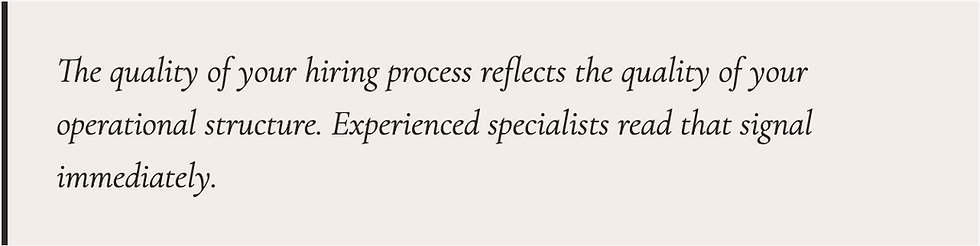
A job description & brief that clearly communicates the business context, the strategic framework, and the specific expectations of the role does not just attract better candidates — it repels the wrong ones. A strong brief signals to good specialists that this is a business worth working with. A vague one signals the opposite.
A strong brief doesn't come from better writing. It comes from clarity that has to exist before the brief is written — in the positioning, the marketing direction, and the specific role that needs filling within that. When those are defined, the brief almost writes itself.
Getting this right before opening the search changes the quality of every conversation that follows.


Comments